Pizza Buffet and Lunch Special POS Setup
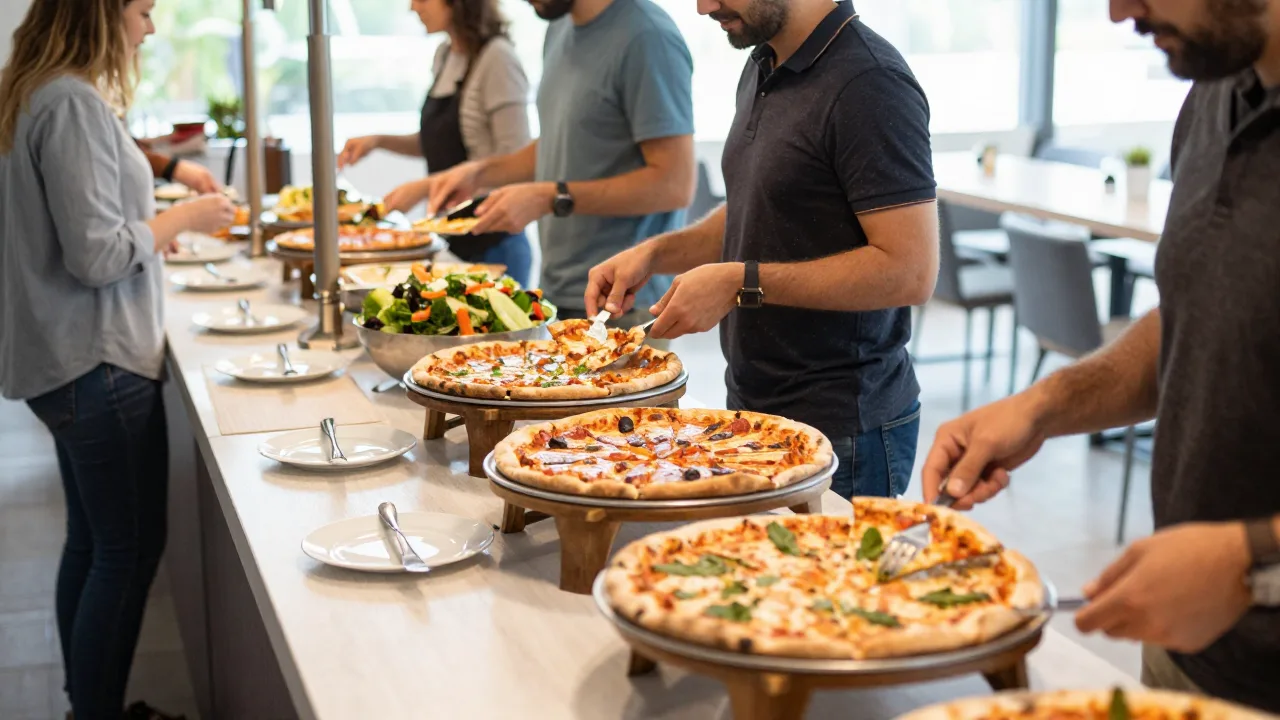
Pull up last week's sales report and find the buffet line. In a typical lunch-buffet pizzeria it will read something like: Lunch Buffet — 341 — $4,429.59. One row. That row is frequently the single largest revenue item in the building, and it contains precisely one piece of information: how many times somebody pressed a button. It does not tell you which pizzas people actually ate, how much food each guest consumed, how many pans went in the bin at 1:50, or whether the guest bought a drink. Your biggest item is your biggest blind spot.
That blind spot has consequences that compound. Without item mix you keep producing the pepperoni-heavy rotation you have always produced, even though the taco pizza empties in nine minutes and the veggie sits until it dries out. Without a per-guest food cost you cannot tell whether $12.99 is a good price or a slow bleed — and buffet food cost drifts, because it is driven by consumption rather than portioning. Without pan-level waste logging you have no idea that 22% of your production goes uneaten in the last 25 minutes of service. And without a drink attach number you are missing the fact that beverages, not pizza, are what make a buffet profitable at all.
None of this requires a bigger buffet or a higher price. It requires instrumenting the thing you already sell. Here is how.
The Four Blind Spots a Flat Buffet Button Creates
Before the fixes, be specific about what is missing, because each gap maps to a different correction.
- Item mix. You know 341 people ate. You do not know they ate 118 pans of pizza with 31% of it being one flavor. Production stays a guess, and the guess is usually wrong in the same direction every week.
- True per-guest cost. Buffet food cost is consumption-driven, so it moves with the weather, the day of week, and who walks in. A construction crew on Thursday and a retirement group on Tuesday do not eat the same amount, and a single blended monthly number hides both.
- Waste attribution. Pans pulled at the end of service disappear into general food cost. They never appear as buffet waste because nothing ever recorded them as buffet production.
- Attach behavior. If the beverage is bundled into the buffet price or rung as an afterthought, you cannot see attach rate, and attach rate is the single most controllable profit lever in the format.
Instrumenting the Buffet Without Slowing the Line
The good news: closing all four gaps adds roughly two seconds to the transaction and about 90 seconds of manager time per shift. Here is the configuration that does it.
Split the button by guest type. Adult, child (ages 4–10), senior, and staff. Four buttons, one tap each, and now your guest count is real. Child pricing at $6.99 against an adult $12.99 matters enormously to your average per-guest cost calculation, and the moment you can separate them you discover that family-heavy shifts and office-heavy shifts have completely different economics.
Prompt the beverage. Configure the buffet items so that selecting one immediately surfaces a beverage prompt on the order screen — fountain, tea, bottled, none. This is the highest-return change on the list. A prompt typically lifts attach rate 8 to 14 points because the guest is asked rather than left to volunteer, and each attached fountain drink at $2.79 against roughly $0.28 in syrup, ice, and cup contributes about $2.51 in gross profit.
Log pan production as a POS event. Every pan that goes to the line gets tapped into a simple production screen: type, time. Every pan pulled unsold gets tapped as waste. That is two taps per pan, maybe 40 taps across a lunch, and it produces the item mix and waste attribution you have been missing. Feed it through the same reporting spine you use for the rest of the shop — the framework in our pizzeria reporting guide applies directly.
Time-stamp the guest count. Because guests are rung on entry, you get a live count of people in the room. That number is what should drive pan cadence, not a fixed timer.
| Per-guest buffet economics | Adult $12.99 | Child $6.99 | Senior $10.99 |
|---|---|---|---|
| Avg. pizza consumed | 3.1 slices | 1.6 slices | 2.2 slices |
| Pizza food cost | $1.02 | $0.53 | $0.73 |
| Salad + dessert cost | $1.35 | $0.70 | $1.15 |
| Allocated pan waste | $0.94 | $0.94 | $0.94 |
| Total food cost | $3.31 (25.5%) | $2.17 (31.0%) | $2.82 (25.7%) |
| With $2.79 drink attached | $3.59 / $15.78 (22.7%) | $2.45 / $9.78 (25.1%) | $3.10 / $13.78 (22.5%) |
Look at the bottom two rows and the strategy writes itself. The drink does not just add revenue — it pulls your blended food cost down by nearly three points because it costs almost nothing to serve. This is the same mechanic that makes bundled pricing work across foodservice generally, and the reasoning behind it is laid out well in this piece on the psychology behind combo pricing.
Pricing the Buffet Around the Attach, Not the Pizza
Most operators price a buffet by looking at the competition and shaving fifty cents. A better method: decide your target contribution per guest, then work backward.
Say your target is $9.50 of gross profit per adult guest. With a $3.31 food cost and 82% drink attach at $2.51 contribution, the math is $12.99 − $3.31 + (0.82 × $2.51) = $11.74. You are $1.76 short. You now have three levers, and only one of them is raising the buffet price: lift attach from 82% to 95% (worth $0.33), add a $2.49 dessert-bar upcharge with 40% take (worth $0.85 net), or cut pan waste from $0.94 per guest to $0.45 (worth $0.49). Do all three and you land at target without touching the headline price that gets you in the door.
That last lever is worth dwelling on. Pan waste allocated per guest is almost always the largest single controllable input and almost never measured. It is also the one your competitors have not touched, which makes it a quiet advantage — and it fits with the broader set of tactics for lifting restaurant sales without discounting that work best when the underlying cost picture is visible.
Time-Boxed Lunch Specials the Register Enforces
Lunch specials fail in two directions, both of them boring and both of them expensive. Direction one: the opener forgets to switch on the special, so the 11:15 guests pay full price, get annoyed, and the promotion you advertised does not run. Direction two, far more costly: nobody switches it off, and $8.99 lunch pricing runs through a 6 p.m. dinner rush at 30% below menu.
Both disappear with scheduled price levels. Define the window precisely — 11:00 a.m. to 2:00 p.m., Monday through Friday — and let the clock do it. A few configuration details make the difference between a schedule that works and one that generates arguments:
- Anchor to order start time, not payment time. A guest seated at 1:52 should get lunch pricing on the whole ticket even if they pay at 2:20. Systems that price at settlement create a nasty conversation at exactly the wrong moment.
- Set a hard stop on new orders. Lunch pricing applies to tickets opened inside the window. After 2:00, new tickets are dinner. No ambiguity, no negotiation.
- Handle the manager override deliberately. Allow it, require a reason code, and report on it weekly. Overrides are legitimate; unmeasured overrides become a pricing policy nobody chose.
- Mirror the schedule online. If the web menu shows lunch pricing at 3 p.m., you will honor it, and you should — so make sure one schedule drives both channels.
- Report specials separately. Lunch-special covers, average check, and attach rate should be their own report line, or you will never know whether the promotion built traffic or just discounted the traffic you already had.
Pan Cadence and the Labor It Drives
Once the register knows how many guests are in the room, production can follow the room instead of a timer. At peak flow — usually 11:45 to 12:40 — a pizza pan wants refreshing every 10 to 14 minutes. In the tail, stretch that to 20 to 25 minutes and, more importantly, cut variety: five pizza types at 1:45 is four types too many. Guests arriving in the last twenty minutes are far more tolerant of limited choice than of tired product, and the pans you do not bake are pure margin.
The labor side follows the same curve. A buffet lunch typically needs one dedicated line attendant from 11:30 to 1:15 and can drop to a shared role outside that band. Scheduling to the actual guest-count curve rather than to a flat 11-to-2 block usually recovers three to five labor hours a week per shop, which is the kind of number that shows up in the labor cost picture immediately.
Case Study: Villa Rosa Buffet, Springfield MO
Villa Rosa runs a weekday lunch buffet from 11 to 2 in a 120-seat room, averaging 268 guests a day. Everything was rung on one $11.99 button, drinks were included in the price, and pan production was managed by whoever was on the line. Baseline measurement over three weeks found blended food cost at 34.8%, pan waste of 27 pans a week going unrecorded, and no way to see item mix at all. They rebuilt the setup in an afternoon: four guest-type buttons, drinks unbundled to $2.49 with an on-screen prompt, pan production and pull logged with two taps, scheduled price levels replacing the manual switch, and pan cadence driven by live guest count. Twelve weeks later the picture was unrecognizable. Drink attach landed at 86%, which more than covered unbundling the beverage — effective revenue per adult guest rose from $11.99 to $14.13. Pan waste fell from 27 to 11 pans a week once the tail-end variety was cut. Item mix data revealed that a chicken-bacon-ranch pie emptied in an average of 8 minutes while a veggie pan lasted 41; rotating production toward the fast movers cut both waste and complaints. Blended food cost settled at 26.9%, and the dinner-pricing leak from an un-switched special — which the owner had never quantified — turned out to have been running about $310 a month.
Stop Selling Your Biggest Item Blind
KwickOS handles buffet guest types, beverage prompts, two-tap pan production and waste logging, live guest counts for pan cadence, and clock-scheduled lunch pricing across counter and web. Built for pizzerias that need operations and reporting to match the shop floor.
Start your free trial — no credit card needed →The Bottom Line
A buffet is not a simple product. It is a production line, a pricing scheme, and a consumption model wearing a single price tag — and if the register only records the price tag, you are running the largest part of your lunch business on folklore. Split the button so guest counts are real. Prompt the drink, because the drink is the margin. Log pans in and pans out so waste stops hiding inside general food cost. Let the clock run your specials so nobody has to remember. Then compare the resulting per-guest numbers against what your inventory system says you actually used and against your true cost per pie. Two afternoons of setup, and the least-understood line on your sales report becomes the best-understood one.