Pizza by the Slice: Counter Speed and Waste Control
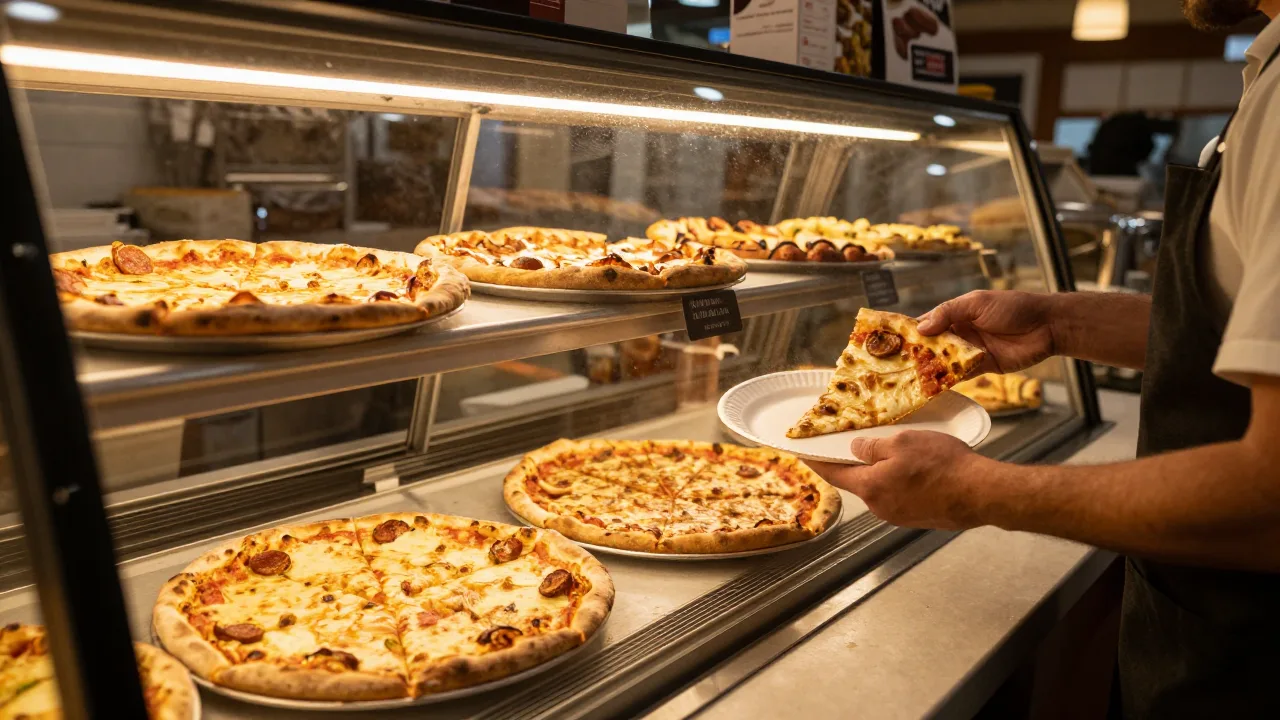
2:40 p.m. on a Tuesday. Nine slices are sitting under the lamps — four pepperoni, three cheese, two Sicilian — and the lunch rush ended forty minutes ago. The next real wave of foot traffic is at 5:15. You know what happens to those nine slices, and so does everyone behind the counter: two get sold to stragglers, one gets eaten by staff, and six go in the bin around four o'clock, quietly, without anyone writing it down. That is roughly $22 of retail value and eight minutes of oven time, gone on a Tuesday nobody will remember.
Now stack that up. Six slices a day at a $3.75 average is $8,200 a year in lost revenue from one slow afternoon repeated 365 times — and that assumes only one dead window per day. Most counters have two: the mid-afternoon lull and the last ninety minutes before close. Meanwhile the same shop runs out of pepperoni at 12:10 on Fridays and turns away customers who walk two doors down. Overproduction and stockouts are not opposite problems. They are the same problem, which is that the case is being filled by feel instead of driven by a number.
The fix is not a bigger warmer or a stricter manager. It is treating the slice case as a production system with a demand curve, a clock, and a ledger. Here is how that works in a real shop.
The Two Numbers That Run a Slice Counter
Everything else is downstream of these. The first is slices per hour by type, pulled from your own sales history in 30-minute intervals. The second is hold life in minutes, which varies by pizza. Get both written down and the entire operation becomes arithmetic instead of instinct.
Hold life is where most shops are dramatically over-optimistic. A plain cheese slice on a well-tuned lamp stays genuinely good for about 35 to 45 minutes. A slice loaded with fresh mozzarella, mushrooms, or heavy sauce is visibly declining at 25. A thick Sicilian with a sturdy crumb can push an hour. These are quality windows, not safety windows — the health code is satisfied as long as the product holds above 135°F — but quality is what determines whether the customer comes back on Thursday.
| Slice type | Quality hold window | Typical waste driver | Bake-ahead depth |
|---|---|---|---|
| Cheese | 40–45 min | Overbaking the buffer pie | 2 pies |
| Pepperoni | 35–40 min | Peak stockout, then overcorrection | 2 pies |
| Sicilian / thick | 55–60 min | Slow mover held too long | 1 pie |
| Veggie / wet toppings | 20–25 min | Sogginess before it sells | Bake to order |
| Specialty / premium | 30–35 min | Baked on hope, not demand | Half pie |
Bake to a Rolling Forecast, Not to a Full Case
Here is the habit worth breaking: baking to fill the display. A full case looks abundant, and abundance sells — but only during hours when there is someone to sell to. Outside those hours a full case is just inventory with a countdown timer on it.
Replace it with a rolling window. Every 15 minutes, the person on the make line answers one question: how many slices of each type does the next 45 minutes need? The answer comes from your interval history, adjusted for what is on the ground. Bake to that number, plus one pie of your top seller as a buffer, and no more.
Pulling the data is the easy part — any POS worth having will export slice sales by 30-minute interval for the last eight weeks. Average each interval by day of week and you have a curve that is usually accurate within 15% for a shop with stable traffic. Print it. Tape it by the oven. The point of the printed curve is that it survives a shift change, which a manager's intuition does not.
One more adjustment matters: the decay ramp. In the last 90 minutes before close, cut the forecast by roughly 40% and stop baking specialty pies entirely. Most slice shops do the opposite — they keep the case looking full until 20 minutes before lockup — and that single habit accounts for a large share of annual waste. The technique is the same one used by every disciplined quick-service operation where the counter is the entire business: production tapers with the demand curve, not with the clock on the wall.
Hold Time Is a Clock, Not an Opinion
Every tray that comes out of the oven gets a time on it. Not a mental note — a physical timestamp, either a printed sticker from the prep station display or a grease-pencil mark on the tray rail. When the window expires, the slice comes off the line. Full stop.
Two things happen when you do this. First, quality stabilizes, because nobody is making a judgment call about a slice they baked themselves two hours ago. Second — and this is the part operators do not anticipate — the timestamps become data. Once you are logging bake time and pull time, you can see which types are consistently expiring and which are consistently selling out, which is exactly the signal your bake forecast needs to correct itself.
A practical middle step before the bin: the discount window. In the final 10 minutes of a slice's hold life, it becomes eligible for a two-for-one or a dollar-off staff-offered upsell. Recovering half a slice's retail value beats recovering none, and it turns a loss into a small margin plus a customer interaction. Just make sure the discount is a POS button with its own reporting code, or you will never be able to tell recovery sales from unauthorized comps.
Where the Seconds Actually Go at the Counter
Counter speed is a revenue question, not a hospitality nicety. A slice counter that turns 70 transactions an hour instead of 45 is not 55% busier — it is 55% larger, using the same square footage and the same labor. Yet in most shops the bottleneck is not the person; it is the number of taps the register demands.
- Fixed slice pricing, one tap. Cheese slice, pepperoni slice, and specialty slice should be three buttons on the home screen with no submenu. Every modifier screen you add to a slice costs three to five seconds per order.
- Combo buttons for the actual combos. Two slices and a fountain drink is the most-ordered configuration in most slice shops. It should be one button, not three, and it should be priced as a combo so the guest stops doing arithmetic at the register.
- Payment at the front of the interaction. Tap-to-pay clears in about 3 seconds versus 12 to 20 for chip insert. Position the terminal so guests can start paying while the slice is being boxed, not after.
- No name capture for slices. Order names make sense for made-to-order pies. On a slice handed across the counter in 20 seconds, it is pure friction.
- One person, one job, at peak. Splitting cut-and-serve from ring-and-pay above roughly 50 transactions an hour typically adds 30% throughput for one extra body.
The broader discipline here — measuring where seconds disappear and removing the taps that cause them — is covered well in this guide to cutting seconds out of a quick-service line, and it applies almost unchanged to a slice window. The specifics of what the register itself needs to support are laid out in our breakdown of slice shop POS requirements.
The Waste Ledger Nobody Keeps
Ask a slice-shop owner what their waste percentage is and you will usually get a shrug and a guess that is too low by half. The number is not hard to produce: slices discarded divided by slices baked, logged by hour. What makes it hard is that nobody wants to write down the thing they threw away.
Make it a 10-second entry on a clipboard or a POS waste button, with three fields: type, count, hour. Nothing else. After two weeks you will have a heat map showing exactly which intervals produce your losses, and it is almost never spread evenly — typically 60–70% of daily waste comes from two specific windows. Fix the bake cadence in those two windows and most of the problem disappears without touching anything else.
For the dollars, run the waste count against your real cost per pie rather than a menu price. At a $2.60 food cost on a 16-inch cut into eight, a discarded slice costs you $0.33 in product — but the honest number includes the labor and oven capacity behind it, which is why labor cost management on a slice line and waste control are the same conversation.
Case Study: Ninth Street Slice, Philadelphia PA
Ninth Street Slice is a 14-seat counter shop doing about 640 slices a day across a lunch peak and a late-night window. The owner tracked no waste at all and baked to keep the case full from 11 a.m. to 11 p.m. A two-week baseline count found 82 slices a day going in the bin — 12.8% of production — with 71% of that loss occurring between 2:15 and 4:30 p.m. and in the final hour before close. They made three changes: a printed interval forecast taped by the oven, grease-pencil timestamps on every tray with a 40-minute cheese window, and a decay ramp that cut baking by 40% after 9:30 p.m. They also collapsed the two-slice-and-a-drink order into a single combo button. Eight weeks later, waste was down to 5.4% of production, saving roughly $9,600 a year in food and recovering close to $19,000 in slices that now get sold instead of binned. Average transaction time at the lunch peak fell from 47 seconds to 31, which the owner measured with a stopwatch across 40 tickets before and after.
A Slice-Counter Operating Routine
Put it together and the daily rhythm is short enough to actually stick.
- Open with the curve. Post today's interval forecast where the oven person can see it. Ninety seconds of prep, and it removes every "should I bake another?" question for the rest of the day.
- Bake in 45-minute windows. Every quarter hour, look ahead 45 minutes and bake the gap plus one buffer pie of the top seller.
- Timestamp every tray. No exceptions, including staff pies. The clock is the rule.
- Work the discount window. Ten minutes before expiry, offer it. Ring it on its own button so recovery shows up in reporting.
- Log the bin. Type, count, hour. Ten seconds.
- Ramp down after the last peak. Cut forecast 40%, stop specialty bakes, let the case run thin. A slightly empty case at 10:40 p.m. costs nothing; a full one costs $22.
- Review Friday. Fifteen minutes with the week's waste heat map and interval sales. Change one thing. Only one, so you can tell whether it worked.
Run the Case on Numbers, Not Guesses
KwickOS gives slice counters interval-level sales history, one-tap slice and combo buttons, hold-time tracking with expiry alerts, and a waste log that ties straight to your food cost report. Built for pizzerias that need operations and reporting to match the shop floor.
Start your free trial — no credit card needed →The Bottom Line
A slice counter is the most forgiving format in pizza and the easiest one to bleed dry, because every mistake is small and none of them are written down. Give the operation a forecast so the oven knows what to make, a clock so the lamp knows when to stop, and a ledger so Friday's review has something to look at. Then take the friction out of the transaction itself, because at 12:15 on a weekday the difference between 45 and 70 transactions an hour is the difference between a shop that is busy and a shop that is profitable. None of this requires new equipment. It requires deciding that the case is a production line, and running it like one.