What Is Pizzeria Rush Hour Management?
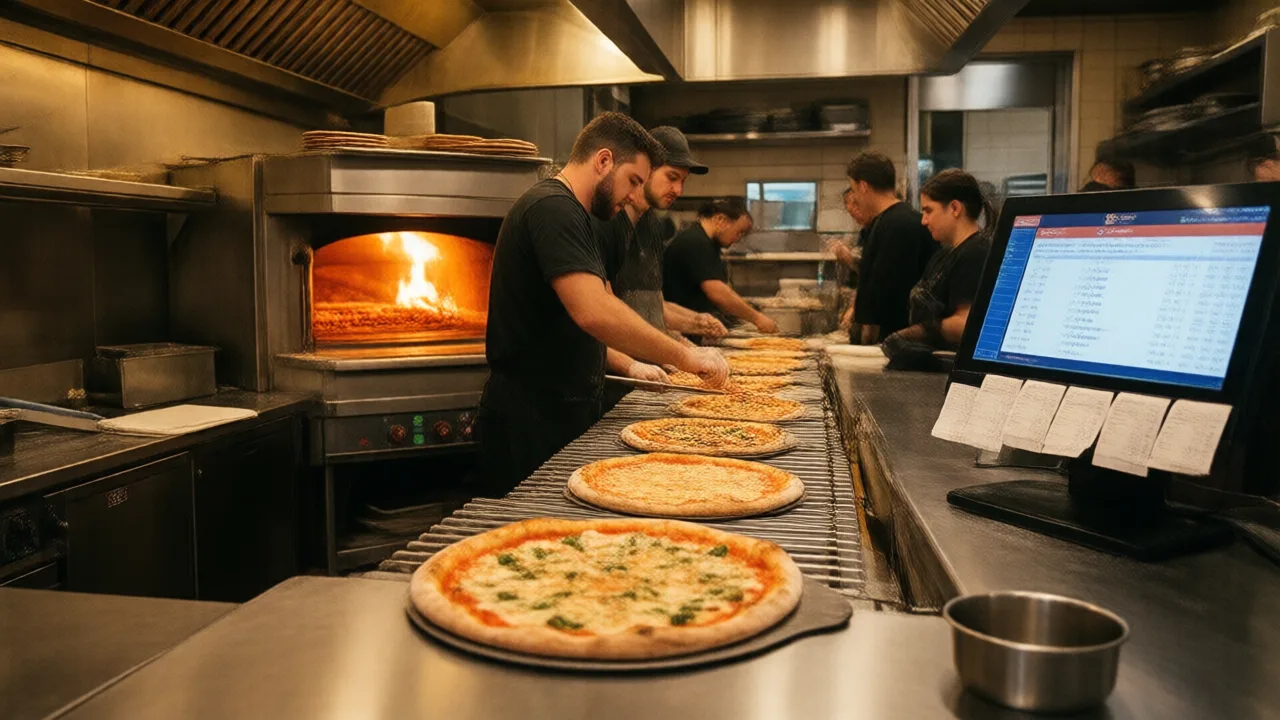
Walk into a busy pizzeria at 6:45 on a Friday and you can read the whole operation in about ten seconds. Either the tickets are moving in a steady line and the make table is calm, or the phone is ringing into a void, three drivers are standing around waiting on the oven, and a walk-in customer at the counter is being told “about forty-five minutes” with the tone of someone who knows it will be an hour. Same menu, same ovens, same night. The difference is management of the rush — not more effort, but a system.
Here is why it matters more than almost anything else you do. A typical American pizzeria concentrates 40% to 55% of its weekly revenue into roughly twelve to fifteen hours a week. The slow Tuesday lunch is nearly irrelevant to the P&L. The Friday and Saturday dinner peaks are the whole game. Which means a shop that runs its rush well and a shop that runs it badly can have identical food, identical marketing, and wildly different bank balances — because one of them turns the peak into revenue and the other turns it into blown pickup times, one-star reviews, and burned-out staff who quit in September.
So let us define the thing precisely, take apart the bottlenecks that actually break, and lay out a playbook you can run this weekend.
What Rush Hour Management Actually Means
Rush hour management is not “working faster.” A make-line cook already moves as fast as a human can when it is slammed; telling them to hurry adds errors, not pizzas. The discipline is about the flow of orders through a fixed set of constraints, and it rests on one uncomfortable truth: your shop can only produce as fast as its slowest station allows. That station is your bottleneck. During a rush it is almost always the oven, occasionally the make line, and — more often than owners admit — the phone.
Good rush management does three things at once. It identifies the bottleneck for that specific shift, it paces every upstream station to feed the bottleneck without flooding it, and it protects the promise — the pickup or delivery time you quoted the customer — because a broken promise is what turns a busy night into a reputation problem. Everything below is in service of those three jobs.
The Five Bottlenecks That Break During a Rush
1. The phone
The most underrated failure point in the building. During peak, a single ringing line ties up a staff member for two to four minutes per call, and every unanswered ring is a lost order that a competitor two blocks away just captured. Industry call-tracking data consistently shows pizzerias missing 20% to 30% of inbound calls during their busiest hours — not because nobody tried to answer, but because the person who would answer is boxing an order or running a card. Getting phone orders off the staff's hands, or routing overflow to AI phone answering that never puts a caller on hold, frees the whole front counter and stops the silent revenue leak. For the mechanics of speeding up the calls you do take, our guide to pizza phone order efficiency breaks down the scripting and workflow.
2. Order entry and channel chaos
Walk-ins on the register, phone orders on a notepad, your website orders on the POS, and three delivery tablets each beeping in their own dialect. When every channel is a separate stream, no one can see the true queue, and the same oven gets committed to five sources that do not know about each other. The fix is consolidation: every order — dine-in, phone, web, and marketplace — landing in one ticket stream the whole team reads from. Pulling third-party delivery into the POS directly, as covered in this walkthrough of consolidating third-party delivery orders into one screen, removes the tablet shuffle that quietly eats your peak.
3. The make line
When tickets pile faster than cooks can build, quality is the first casualty: portions drift, wrong toppings slip through, and rebuilds cost you an oven slot you cannot spare. The lever here is visibility and pre-staging. A prep-station display puts each build right where the cook works so nobody hunts for a paper ticket, and pre-portioning cheese, sauce, and high-volume dough balls before the rush means the line assembles instead of measures. A well-run make line during peak is boring to watch — that is the goal.
4. The oven
The hard ceiling. No amount of staffing makes an oven bake faster than its cycle, so the oven's real throughput is the number every promise must respect. A single-deck conveyor at an 8-minute bake produces roughly 40 to 60 twelve-inch pies an hour at practical loading; a wood-fired Neapolitan bakes in 90 seconds but holds only a handful at a time. If you do not know your oven's true hourly ceiling, you are quoting pickup times on hope. Measure it on a real Friday, then pace order intake so the queue never exceeds what the oven can clear inside your promised window.
5. Delivery dispatch
The last hundred feet. Drivers stacking up waiting on pies, or leaving with one order when they could take three going the same direction, quietly doubles your delivery cost and your delivery times during the exact window when both matter most. Batching by zone and timing driver departures to oven-out rather than order-in keeps the road side of the operation from becoming the bottleneck the kitchen worked so hard to avoid.
Reading the Symptoms in Real Time
Every rush failure shows a tell before it becomes a disaster. Learn to read them and you can intervene while there is still time to fix it rather than after the reviews land.
| Symptom on the floor | The real bottleneck | The move |
|---|---|---|
| Phone ringing while staff box orders | Phone / labor | Route overflow off the counter; dedicate one person to phones or automate |
| Drivers idle by the oven | Oven throughput | Stop promising times the oven can't hit; batch driver runs |
| Wrong or remade pizzas climbing | Make line overload | Add a builder, pre-stage portions, use a make-line display |
| Quoted times sliding past actual | Broken promise loop | Switch to dynamic quoting off the live oven queue |
| One delivery app flooding tickets | Channel chaos | Pause that marketplace 20–30 min; consolidate into POS |
A Rush-Hour Playbook You Can Run This Weekend
The best operators do not improvise the rush. They run a routine that starts before the first ticket and ends after the last driver returns.
- Know your oven number. Measure real pies-per-hour on a live Friday, not the manufacturer's spec sheet. Every promise you make flows from this one figure.
- Pre-stage before 5 p.m. Portion cheese and sauce, pre-ball dough, cut boxes flat-to-formed, and top off every station. Ten minutes of measuring at 6:30 is ten pies you did not bake.
- Consolidate the channels. Get phone, web, dine-in, and marketplace orders into one ticket stream so the whole team sees the same queue and the oven is committed once, not five times.
- Quote dynamically. Base pickup and delivery times on the current oven queue, not a fixed “30 minutes.” An honest 50-minute quote beats a hopeful 30 that becomes 55 every time.
- Assign the bottleneck a keeper. One person owns the constraint — usually a designated oven-tender who controls load order and calls out timing to the make line and dispatch.
- Protect the pace with channel pausing. If a delivery app floods the queue, pause it for 20 to 30 minutes to protect the customers already promised a time, then reopen when the oven clears.
- Debrief in five minutes at close. What was tonight's bottleneck? Where did we blow a time? One note per shift builds a pattern you can staff against within a month.
Staffing to the Curve, Not the Clock
Most pizzerias schedule in blunt blocks — a 4-to-close shift for everyone — which either overstaffs the 4:30 lull or understaffs the 6:15 wall. Rush management means staffing to the demand curve your own sales data already draws. Pull your last eight Fridays by fifteen-minute interval and the peak reveals itself precisely; then stagger arrivals so your fullest crew is on the floor for the ninety minutes that actually matter and not a moment before. The payoff is double: labor cost drops on the shoulders of the shift, and the peak is fully covered. Cross-training helps here too — a cook who can jump to phones for ten minutes when the calls spike is worth more during a rush than a specialist standing idle at a slow station. For the raw throughput comparison that tells you how much a faster system buys you at peak, see our pizzeria POS speed comparison, and the case for screens over paper is laid out in the kitchen display system benefits guide.
Case Study: Vesuvio Pizza Co., Grand Rapids MI
Vesuvio is a two-oven neighborhood shop doing about $27,000 a month, with better than half of it landing in the Friday and Saturday 5-to-8 windows. The owner described the rush the way many do: “organized panic.” A month of five-minute closing debriefs surfaced the same bottleneck almost every night — not the ovens, which had headroom, but the phone. Two staff were pulled off the make line and register for two to four minutes per call, and a call-tracking audit showed 26% of Friday-peak calls going unanswered. They made three changes: routed phone overflow to an automated answering line so no call went unanswered, consolidated the two delivery tablets into the POS ticket stream, and switched from a flat “30 minutes” quote to a dynamic time pulled off the live oven queue. Over the next two months, missed peak calls fell from 26% to under 4%, remade pizzas dropped by roughly a third as the make line stopped getting yanked to answer phones, and Friday revenue rose about 11% — almost entirely from orders that used to ring out unanswered. No new oven, no new square footage. Just management of the three hours that mattered.
Learn How KwickOS Handles the Rush
From one consolidated ticket stream to oven-aware quoting and make-line displays, KwickOS is built to keep a pizzeria fast and accurate when the peak hits. See how the platform brings phone, web, delivery, and dine-in into a single flow.
Learn more about KwickOS for pizzerias →The Bottom Line
Rush hour management is the highest-leverage skill in a pizzeria, because the rush is where the money is and where the reputation is made or lost. The mechanics are not exotic: find the shift's real bottleneck, pace every station to feed it, quote honestly off the live queue, and get the phone and the channel chaos out of the way so the kitchen can do what it does. Do that consistently and the busiest three hours of your week stop being organized panic and start being the most profitable, calmest part of the schedule. The slow Tuesday will never make your year. Friday at 6:45 always will — and the next obvious lever is giving guests a fast direct online ordering channel so more of that peak volume arrives clean, priced right, and already in your queue.