Pizzeria Third-Party Delivery Reconciliation
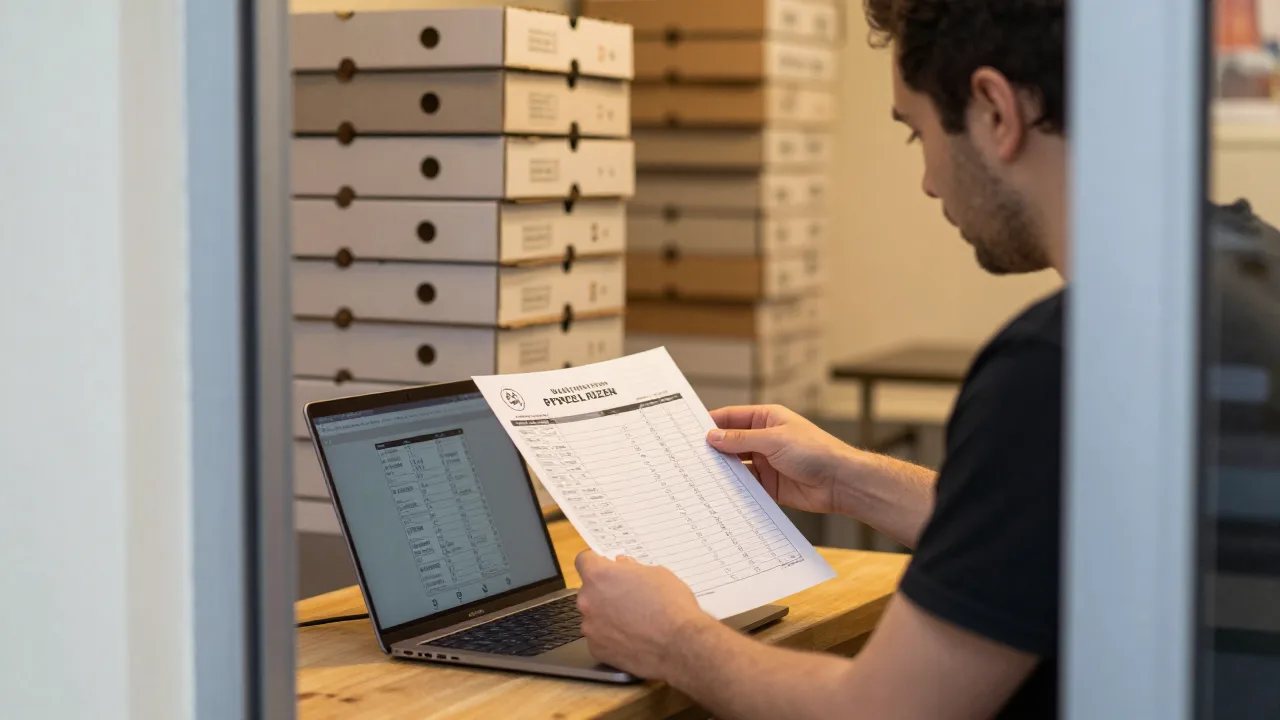
Here is a number that ruins a Tuesday. Your POS says the marketplace sent you $4,318 in orders last week. Fourteen days later, $2,986 lands in the account. The gap is $1,332 — 30.8% — and when you open the app's dashboard you find a single summary screen that says, more or less, that the number is the number. No line items you can tie to a ticket. No explanation for why this week's rate came out five points worse than the week before.
Most pizzeria owners handle this by deciding the gap is the cost of doing business and moving on. That instinct is half right. A meaningful chunk of the deduction is genuinely contractual — you signed a commission tier and you are getting billed for it. But in nearly every shop I have looked at, somewhere between 2% and 6% of marketplace gross is not contractual. It is refunds nobody contested, promotions that were co-funded at a share nobody agreed to, orders that never made it into the POS at all, and price mismatches between your marketplace menu and your real one. On $9,000 a month of app volume, that band is $180 to $540 — every month, indefinitely, because nobody ever looked.
The work of looking is not large. It is about 25 minutes a week once you have the process built. What follows is the process.
Anatomy of a Marketplace Deposit
Before you can find what is wrong, you have to know what right looks like. Every marketplace deposit decomposes the same way, whatever the branding on the dashboard.
| Line | Example week | Notes |
|---|---|---|
| Gross subtotal (food) | $4,318.00 | Menu prices × quantity, pre-tax |
| Commission on subtotal | −$1,079.50 | 25% tier in this example; ranges 15–30% |
| Marketing / promoted listings | −$172.72 | Optional; typically 3–15% of attributed sales |
| Promotion co-funding | −$96.40 | Your share of BOGO, free delivery, dollars-off |
| Customer refunds & adjustments | −$143.85 | The contestable line — 2–4% is typical |
| Processing fee | −$129.54 | Often ~3% where charged separately |
| Tax collected & remitted by marketplace | $0.00 net | Passes through in most states; verify locally |
| Net deposit | $2,695.99 | 62.4% of gross |
Now compare that to your own expectations. If your contract is 25% commission plus 3% processing and you are not buying ads, your net should be around 72% of gross. Landing at 62% means roughly $430 of the week went to promotions, refunds, and marketing you may or may not have chosen. That is the number worth chasing — and the reason to read every line rather than the summary. For the wider economics of what these programs cost across a year, this analysis of what delivery commissions really cost a restaurant sets useful benchmarks.
The Four Places the Money Actually Goes
1. Refunds charged back without evidence
This is the biggest recoverable category and the one most operators never touch. A customer reports a missing item or a cold pizza; the marketplace refunds them and debits you. Whether that debit sticks depends almost entirely on whether you can produce evidence within the dispute window — commonly 7 to 14 days.
Shops that photograph every marketplace order at the packing station, with the printed ticket visible in frame, routinely recover 40% to 60% of contested dollars. Shops without photos recover close to zero, because the marketplace has one account of what happened and you have none. The photo takes four seconds. At a 3% refund rate on $9,000 monthly volume, you are contesting about $270 a month and recovering perhaps $135 — $1,600 a year for a habit that costs one phone mount.
2. Promotion co-funding nobody re-read
Promotions get switched on during a slow month and then never switched off. Worse, the co-funding split is buried in a screen most owners visited once. Free delivery on orders over $25 sounds harmless until you notice you are funding $2.99 of it on 40% of your tickets. Audit your active promotions monthly — a five-minute task — and kill anything you cannot tie to a measurable lift in order count.
3. Menu price mismatch
If your marketplace menu was built eighteen months ago and your in-store prices have moved twice since, you are selling pizzas on the app at old prices and paying commission on them. A $17.99 large that still lists at $15.99 is a $2.00 loss plus $0.50 of foregone commission-adjusted margin, on every single order of that item. Set a calendar reminder to sync marketplace menus every time you change in-store pricing, without exception.
4. Unmatched orders
The quiet one. An order exists in the marketplace's file and not in your POS — or vice versa. Usually this is a tablet order somebody keyed in by hand at 8:40 on a Friday and got wrong, or a dropped integration nobody noticed for two hours. In tablet-based shops the unmatched rate runs 1% to 3% of volume, and each unmatched order corrupts three things at once: your sales reporting, your inventory deduction, and your tax records.
The structural fix is to stop retyping orders. Direct integration — where marketplace tickets land in the POS as native orders — removes the transcription step and gives you the matched order IDs that make reconciliation possible in the first place. Both our overview of integrating delivery apps with a pizzeria POS and this walkthrough of connecting third-party delivery orders directly into the POS cover how that plumbing works in practice.
A Weekly Reconciliation That Takes 25 Minutes
Fixed day, fixed order of operations. Tuesday works well for most shops because the prior week's deposits have posted and the dispute windows are still open.
- Export order-level detail from each marketplace for the deposit period. Summary screens are not enough; you need one row per order with an order ID, subtotal, and every deduction.
- Export the matching period from your POS, filtered to marketplace tender types.
- Match on order count first. If the counts differ, stop and find the unmatched orders before doing anything else. Everything downstream is unreliable until the counts agree.
- Match on gross subtotal. A gap here is a menu price mismatch, and it will point straight at the specific items.
- Verify the commission rate against your contract tier. Rate creep is rare but it happens, especially after a plan change or a promotional trial period expires.
- Pull every refund and adjustment into a list. For each, check whether you have packing evidence. Dispute the ones you can support. Do this the same day, because the window is short.
- Review active promotions and marketing spend. Compare attributed order lift against what you paid. If a promoted listing cost $173 and drove 11 incremental orders at an $8 contribution, it lost money.
- Log the week's effective take rate — net deposit divided by gross — in a running sheet. The trend line is what catches slow problems; a single week never does.
Once the routine exists, feed the resulting numbers into the same weekly review you use for the rest of the business. Marketplace channel margin belongs next to your dine-in and direct-delivery numbers, not in a separate folder — the structure in our pizzeria reporting guide handles that comparison cleanly.
Winning Disputes Instead of Filing Them
A dispute is a document-production exercise, not an argument. The submissions that succeed share the same three attachments: a timestamped kitchen ticket showing the exact items produced, a photo of the sealed order with the ticket visible, and the handoff time showing when the driver took possession. That last one matters more than operators expect, because a large share of quality complaints concern food that was fine when it left and spent 34 minutes in a car.
Two operational habits make this evidence automatic rather than heroic. First, a phone or tablet mounted at the packing station with a one-tap photo tied to the order number. Second, capturing driver handoff time in the system rather than in someone's memory — which is a standard capability in a proper delivery management setup. With both in place, filing a dispute takes about 90 seconds and the recovery rate stops depending on how good your memory is.
The Tax Line Deserves Its Own Look
One caution before the case study: this is an operations guide, not tax or legal advice. Marketplace facilitator rules — which determine whether the delivery platform or the restaurant is responsible for collecting and remitting sales tax — vary by state and have changed repeatedly. In most states the marketplace now collects and remits on orders placed through its platform, which means those sales should be reported differently on your return than your direct sales. Getting this wrong in either direction creates a real problem: double-remitting costs you cash, and under-remitting creates a liability. Have your CPA confirm exactly how your state treats marketplace-facilitated sales and how they should appear in your POS tax reporting, and then configure the tender types to match that answer rather than guessing at it.
Case Study: Bellini Brothers Pizza, Toledo OH
Bellini Brothers runs a single shop doing about $11,400 a month across two delivery marketplaces, roughly a third of total revenue. The owner had never reconciled — deposits went into the bank and the bookkeeper coded them as sales. A one-month audit found four problems at once. Twenty-three orders in the period existed on the apps but not in the POS, all from hand-keyed tablet tickets, worth $487 of unrecorded sales that also never deducted inventory. Fourteen large specialty pizzas were still listed at prices from a menu update sixteen months earlier, costing $2.50 each on 61 orders. A free-delivery promotion switched on the previous winter was still running and had co-funded $1,940 over eight months with no measurable order lift. And $412 of refunds over the month had gone entirely uncontested. They put in a direct POS integration to kill the retyping, synced both marketplace menus, ended the stale promotion, and mounted a phone at the packing station for order photos. Over the next quarter: unmatched orders fell to two total, refund recovery ran 51% of contested dollars, and the effective take rate improved from 34.1% to 28.6% of gross. On their volume that is about $7,500 a year, from a weekly routine the manager finishes before the lunch prep starts.
Know What Every Delivery Dollar Really Netted
KwickOS pulls marketplace orders in as native POS tickets, matches deposits to order-level detail, flags unmatched orders and price mismatches, and reports channel margin next to your dine-in and direct numbers. Built for pizzerias that need operations and reporting to match the shop floor.
Start your free trial — no credit card needed →The Bottom Line
Third-party delivery is not inherently a bad channel — it is an expensive one that becomes indefensible when nobody checks the invoice. The contractual commission is what it is. The other 2% to 6% is a series of small, fixable leaks: refunds you could have contested, promotions nobody switched off, menu prices that never got synced, and orders that were retyped by hand at the worst hour of the week. Match the counts, match the subtotals, contest the refunds inside the window, and log your effective take rate every week so the trend has somewhere to show up. Then take the obvious next step and give guests a reason to skip the app entirely — a well-run direct online ordering channel keeps the full ticket and the customer relationship along with it.