What Is a Pizza Modifier Matrix? Toppings, Halves, and Pricing Logic
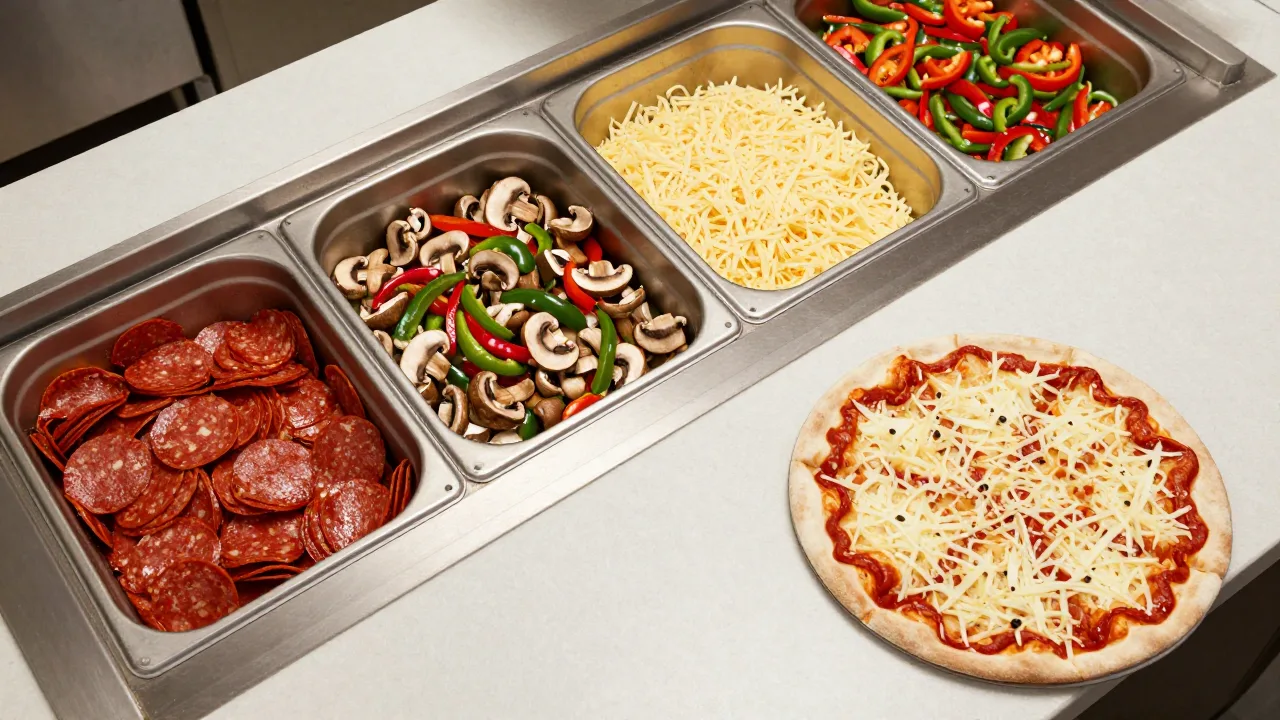
Start with the arithmetic, because it explains everything that follows. A pizzeria carrying four sizes, twenty-two toppings, three intensity levels, and three placement options is not selling a menu item with a handful of options attached. Every topping can be off, light, regular, or extra, and each of those can land on the whole pie, the left, or the right. Multiply that out across twenty-two toppings and the number of distinct pizzas a customer could legitimately order runs past a billion — before you add crust, sauce, and bake preferences. Nobody prices a billion things by hand. So you price the rules instead, and the structure that holds those rules is the modifier matrix.
Here is where it stops being theoretical: every one of those billion builds still has to produce a single number on a receipt, an accurate line on a kitchen ticket, and a defensible deduction from your cheese inventory. When the matrix is right, all three happen automatically and a new cashier is dangerous for about ten minutes. When the matrix is wrong — or missing, which is the more common situation — the register becomes a negotiation, and the negotiation always resolves in the customer's favor.
The Three Axes Every Pizza Modifier Matrix Has to Price
A matrix is only a matrix because it has more than one dimension. Generic restaurant point-of-sale systems typically give you exactly one: a topping is either on the item or off it, at one flat price. Pizza needs three, and skipping any of them pushes the missing decision onto whoever is holding the phone.
Axis 1: Size
Food cost per topping scales with the surface area of the pie, and surface area grows with the square of the diameter. A 10-inch pizza has about 79 square inches; an 18-inch has 254. That is a 3.2× jump. In practice, a standard pepperoni application runs roughly 0.8 oz on a 10-inch and 2.4 oz on an 18-inch, so at $4.10 per pound the raw cost of that same topping goes from about $0.21 to $0.62. Charging one flat topping price across all four sizes means your largest, most-photographed pizzas quietly carry the worst margin on the menu.
Axis 2: Placement
Placement is the axis that separates pizza from every other menu category in foodservice. A guest can order sausage on the left and mushrooms on the right, and both the price and the make-line instruction have to reflect that split. A matrix stores placement as a first-class attribute — whole, left, right, and in some shops quarter — and attaches a price multiplier to each. Systems that lack a placement axis force staff to fake it, usually by ringing a whole-pie topping and adding a comment, which prices the pizza wrong and gives the kitchen no reliable instruction.
Axis 3: Intensity
Light, regular, extra, and double are not cosmetic. Extra cheese on a 16-inch adds roughly 4.5 oz of mozzarella — about $0.85 of product at $3.00 a pound — plus a longer bake and a real risk of a soggy center that comes back as a remake. Light toppings, meanwhile, cost you almost nothing and are worth tracking because a guest who always orders light sauce is a guest whose preferences your system should remember. Each intensity level needs its own price rule and its own inventory deduction factor, or your theoretical food cost will never line up with the walk-in.
| Topping placement & intensity | 10" small | 14" medium | 16" large | 18" X-large |
|---|---|---|---|---|
| Regular, whole pie | $1.25 | $2.00 | $2.75 | $3.25 |
| Regular, one half | $0.65 | $1.00 | $1.40 | $1.65 |
| Extra, whole pie | $2.25 | $3.50 | $4.75 | $5.50 |
| Light, whole pie | $1.25 | $2.00 | $2.75 | $3.25 |
| Premium topping, whole | $2.00 | $3.00 | $4.00 | $4.75 |
Notice the row for light toppings. It charges full price on purpose — you are selling a build, not a weight, and discounting light applications trains guests to order light and then ask the make line for more. That single decision, written into the matrix once, ends a conversation your cashiers would otherwise have three times a night.
The Four Pricing Models, and When Each One Fits
Once the axes exist, you still have to decide how halves get charged. This is where most pizzerias have no written policy at all, and where a matrix earns its keep fastest. Four models dominate the industry, and each is defensible in the right shop.
- Half-price-per-half. A topping on one side costs 50% of the whole-pie price, rounded to the nearest nickel. This tracks food cost almost exactly and guests immediately understand it. It is the default recommendation for shops where half-and-half is more than 15% of orders.
- Highest-half pricing. The pizza is priced as if the more expensive side covered the whole pie. Faster at the register, roughly 8–12% more revenue per half-and-half ticket, and a reliable source of complaints when one side is plain cheese. Common in high-volume delivery shops where speed beats nuance.
- Average-of-halves. Price each half as its own configuration, then charge the mean. Mathematically the fairest model and the hardest to explain over a phone. Best suited to shops with a strong online ordering mix, where the screen does the explaining.
- Flat half-and-half surcharge. A single fee — often $1.50 to $2.50 — on top of the base pie, with toppings priced normally. Simple, but it punishes a guest who wants one topping split and undercharges the guest who builds two elaborate halves.
Now for the part that catches operators by surprise: the model you pick matters far less than the fact that you picked one and encoded it. Two cashiers using two different mental models on the same order type will produce a variance you can actually measure in your reports, and it will look like theft long before anyone realizes it is just a missing rule.
Where Flat Topping Pricing Quietly Loses Money
Run the numbers on a single shop. Say you sell 60 extra-large pizzas a day and 40% of them carry at least two added toppings. Under flat pricing at $2.25 per topping regardless of size, you are collecting the same amount you collect on a 10-inch while spending roughly three times the product. The gap on each topping is about $0.40 in food cost plus the margin you never charged for — call it $1.00 of foregone contribution per topping.
At 48 topping instances a day on extra-large pies, that is $48 daily, $336 a week, and just over $17,000 a year evaporating from a menu decision nobody ever revisits. The fix costs you an afternoon of matrix setup and zero ongoing effort, which is why size-scaled topping pricing is usually the highest-return change available to a pizzeria that has never audited its options. If you want the broader context on how option-level configuration lives inside a point-of-sale system, this walkthrough of how restaurant POS software handles item-level configuration covers the general architecture that pizza-specific matrices sit on top of.
Building Your Matrix: A Seven-Step Setup
Here is the practical sequence. Do it in this order, because each step feeds the next and skipping ahead means redoing work.
- Weigh your actual applications. Before pricing anything, put a scale on the make line and record real topping weights by size for your ten highest-volume toppings. Most shops discover their true applications run 20–30% above spec.
- Cost each topping per size. Convert weight to dollars at current invoice prices. This gives you a floor: no matrix cell should ever price below cost plus your target contribution.
- Sort toppings into tiers. Standard, premium, and specialty. Three tiers is enough; five becomes unmemorable for staff and unmanageable when prices move.
- Choose one half-and-half model from the four above and write it on a laminated card by the register. The card matters as much as the software setting.
- Define intensity multipliers. Typically light = 1.0× price with a 0.6× inventory deduction, extra = 1.75× price with a 1.5× deduction, double = 2.0× both. Getting the deduction factors right is what keeps your true cost per pizza honest.
- Lay out the screen for speed, not for tidiness. Your twelve highest-frequency toppings go on the first screen in fixed positions. Placement and intensity controls stay in the same corner on every screen so muscle memory develops. The details of pizza customization on the order screen are where matrix theory turns into seconds saved per ticket.
- Test with twelve real tickets. Pull a dozen genuinely weird orders from last month — three toppings left, extra cheese right, light sauce whole — and ring each one. If any produces a price you cannot defend out loud, the matrix is not finished.
Case Study: Marchetti's Pizza Kitchen, Dayton OH
Marchetti's runs a single 90-seat dining room with a heavy carryout mix, about 175 pizzas a day. Their previous system charged $2.00 per topping on every size and had no placement field at all, so half-and-half orders were rung as whole-pie toppings with a note. The owner had assumed the resulting mess was a training problem. A four-week audit said otherwise: 22% of half-and-half tickets were priced differently by different cashiers, and extra-large pies were carrying a 41% food cost against a 29% target. Rebuilding the matrix with size-scaled tiers, a half-price-per-half rule, and separate inventory deductions for light and extra took one afternoon. Over the following quarter, average ticket on customized pizzas rose $1.85, extra-large food cost fell from 41% to 30.4%, and cashier price disputes at the counter — which the manager had been logging — dropped from an average of 9 a week to 1. Annualized, the matrix rebuild returned roughly $21,000 on a change that required no new hardware.
What Breaks When the Matrix Is Wrong
The pricing loss is the obvious symptom. The operational damage is worse, and it shows up in four places you might not connect to the register.
The kitchen ticket loses fidelity. If placement is a comment rather than a field, your kitchen display system cannot highlight it, sort by it, or route it. A make-line cook reading a free-text note at 7:15 on a Friday will miss it eventually, and a remade 18-inch costs you roughly $4.80 in product plus eight minutes of oven capacity during your peak.
Inventory variance becomes unreadable. Without intensity deduction factors, every pizza deducts the same cheese whether the guest ordered light or double. Your theoretical-versus-actual number then drifts for reasons that have nothing to do with waste or theft, and you lose the one report that would have caught a real problem.
Online ordering diverges from the counter. Web menus built separately from the in-store matrix are the single most common source of the "that is not what the website said" conversation. One matrix, one source of truth, both channels reading from it.
Training time balloons. Every rule that lives in a person's head instead of the system has to be taught, remembered, and retaught after turnover. Shops that encode the rules report new-cashier competence in a single shift rather than a week — which is the practical argument for a pizza-specific POS over a generic one, and the reason platforms designed for point-of-sale software built around pizza builds treat the matrix as a core object rather than an add-on.
Price Every Half, Every Time
KwickOS ships with a full three-axis pizza modifier matrix — size-scaled topping tiers, true half and quarter placement, intensity-aware inventory deductions, and one menu shared by counter, phone, and web. Built for pizzerias that need operations and reporting to match the shop floor.
Start your free trial — no credit card needed →The Bottom Line
A pizza modifier matrix is not a settings page you fill in once and forget. It is the encoded version of every pricing argument your shop would otherwise have at the counter, on the phone, and in the monthly food-cost review. Give it three real axes — size, placement, intensity. Pick one half-and-half model and write it down. Scale topping prices with surface area, not habit. Set inventory deduction factors that match what actually goes on the pie. Do those four things and the register stops being a source of variance and starts being the most reliable measuring instrument in the building.