Neapolitan and Artisan Pizzerias: What Your POS Needs to Handle
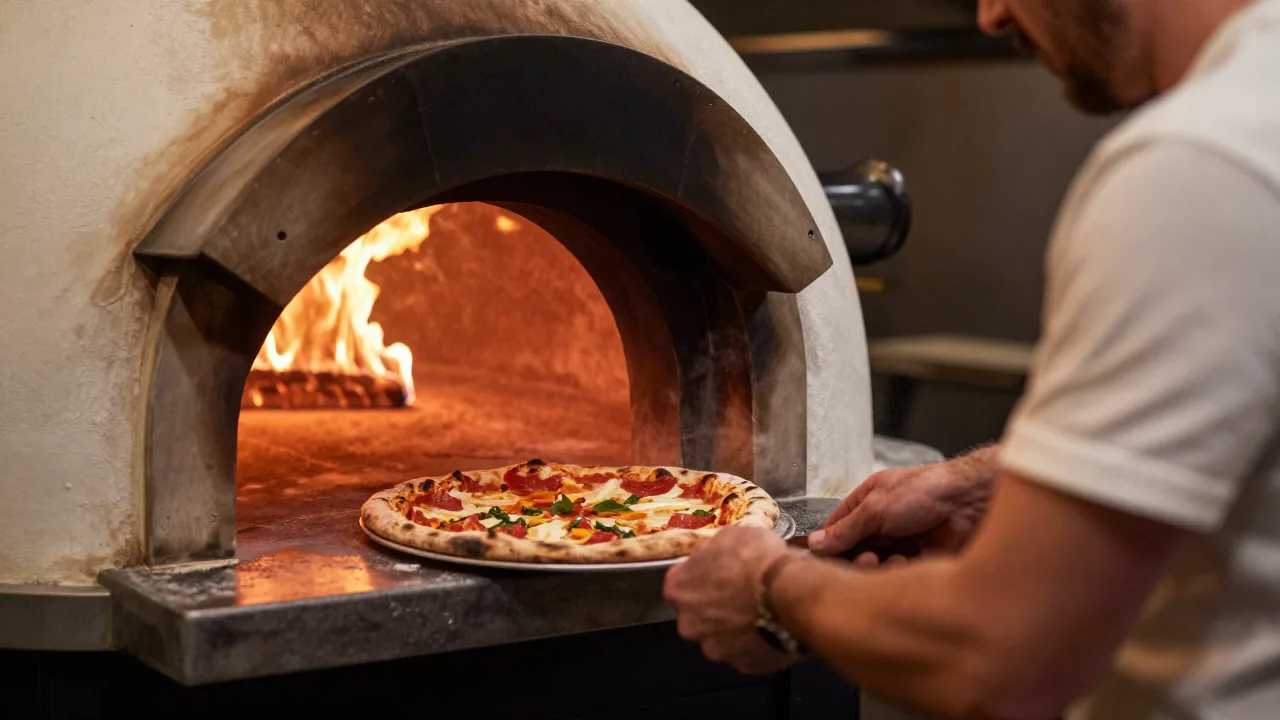
Ninety seconds. That is the entire production window for a Neapolitan pizza in an 850°F dome, and it is the number that quietly rewrites every assumption built into ordinary restaurant software. A conveyor shop can absorb a rush by adding pies to a belt. A dome oven cannot. It holds four to six pies at a time, the pizzaiolo turns each one twice with a peel, and when the deck is full the next ticket simply waits — no matter how urgently it is flashing on a screen.
So the pain in an artisan room does not look like the pain in a delivery shop. Nobody is drowning in tickets. Instead, at 7:35 on a Saturday, four margheritas come out beautifully and then sit on the pass for six minutes because table 12 also ordered an appetizer that the kitchen fired late. The cornicione goes from airy to leathery. The center, already soft by design, weeps. A guest who came specifically for that texture gets something that photographs fine and eats like disappointment — and the shop never finds out, because nobody sends back a pizza they simply did not love.
That is the real cost of a mismatched point of sale in artisan pizza. It is not slow ordering or clumsy reporting. It is a quality tax charged in seconds on the pass, against a product whose entire premium is textural and whose window is measured in single digits of minutes. Here is what the system has to do differently.
Your Bottleneck Is the Oven Mouth
Start by writing down your true capacity, because almost nobody has. It is deck positions divided by bake time, adjusted for the peel work in between. A six-position dome at 75 seconds a pie, with realistic turning and loading, sustains something in the range of 40 to 50 pizzas an hour with a strong pizzaiolo — and closer to 32 to 38 with a second-year cook on a busy Friday.
Once that number exists, it should govern the software. A POS built for artisan service does three things with it:
- Meters the fire. Tickets release to the pass at a rate the deck can absorb, so the pizzaiolo sees a rolling queue of the next six to eight pies rather than a wall of twenty-three.
- Quotes honestly. When the queue depth exceeds capacity, the quoted wait for a walk-in or an online order extends automatically. A shop that quotes 20 minutes and delivers 45 loses the guest; a shop that quotes 45 and delivers 40 gets thanked.
- Throttles the channel mix. When the deck is saturated, online orders pause or lengthen before the dining room suffers. Selling a pizza you cannot bake for an hour is not a sale — it is a refund with extra steps.
The visual half of this lives on the kitchen side. A kitchen display system tuned for a dome oven should show the queue as oven load, not as a chronological list, with the next items to stretch highlighted and the fired items counting up in seconds rather than minutes. A minute-resolution timer is useless when the bake is 90 seconds long.
| Artisan constraint | What a generic POS assumes | What the shop actually needs |
|---|---|---|
| 60–90 second bake | Minute-level ticket timers | Second-level fire timing, oven-load view |
| 4–6 deck positions | Unlimited parallel prep | Capacity-aware pacing and quoting |
| 24–72 hour dough ferment | Ingredients reorderable same day | Dough-ball countdown, auto 86 at zero |
| 8–12 item menu | Category-level reporting | Per-item margin and sell-through |
| Bake-critical toppings | Any modifier on any item | Rule-based allow and block lists |
| Seasonal specials | Static menu maintenance | Fast item creation with costing built in |
The Dough Clock: Selling a Product You Cannot Reorder
Here is the constraint that separates artisan pizza from nearly every other restaurant format: today's dough was made two or three days ago, and there is no way to make more of it before service ends. If you balled 180 at 62% hydration on Wednesday for Friday, then 180 is the hard ceiling on Friday, minus whatever failed to proof correctly.
Most shops manage this with a whiteboard and a shout. It works until it does not — usually at 8:40 p.m. when a server has already promised two pizzas to a four-top. The alternative is treating dough as a live inventory item with a countdown that the register enforces:
- Enter the balled count at open, by size if you run more than one. This is a 20-second task and it is the foundation for everything else.
- Deduct on sale, not on fire. The moment a pizza is rung, the count drops. Deducting at the oven leaves a window where two servers can sell the same last ball.
- Set a soft threshold. At 15 remaining, the POS flags every pizza item amber and notifies the floor. This is the moment to stop selling and start managing expectations, not the moment you hit zero.
- Auto-86 at zero, across every channel at once — counter, tablet, and web. A dough-out that reaches the website ninety seconds late produces an order you have to call and cancel.
- Log the variance nightly. Balls made minus pizzas sold minus recorded losses. A consistent gap of five or six a night is a proofing problem or a stretching problem, and both are fixable once visible.
Do this and something unexpected happens on the marketing side: the dough count becomes a genuine scarcity signal you can use honestly. Shops that post "42 pies left tonight" drive a real early-evening bump, and it is one of the few scarcity tactics in hospitality that is not theater. Independent shops looking for more of that kind of leverage will find a practical set in these marketing approaches that work for independent pizzerias.
A Short Menu Needs Deeper Data, Not Less
Ten pizzas, four antipasti, two desserts. It looks like a menu that barely needs reporting. In fact the opposite is true — when ten items carry 85% of your revenue, each one is load-bearing, and a single weak performer is a structural problem rather than a rounding error.
The reports that matter in a short-menu room are narrow and specific. Contribution margin per item, because your $19 pie with imported buffalo mozzarella and your $16 marinara have wildly different dollar contributions and the higher-priced one is frequently the worse business. Sell-through by hour, because an item that only moves after 9 p.m. is telling you something about who is in the room. And modifier attach rate, because in artisan pizza the add-ons — a fried egg, prosciutto crudo added after the bake, a finishing oil — carry 70–80% margins and most shops never measure whether servers are offering them.
Put those three together and the classic four-quadrant exercise becomes genuinely actionable rather than academic. This guide to engineering a menu around what the kitchen can physically produce lays out the framework; the artisan wrinkle is that your capacity ceiling belongs in the analysis. On a saturated Saturday, the right question is not which pizza is most profitable but which pizza is most profitable per oven slot, and those are not always the same answer.
Modifiers That Respect the Bake
Craft shops tend to swing to one of two extremes: allow nothing, which frustrates guests and hands the server an argument at every table, or allow everything, which produces pizzas the oven cannot execute. The workable middle is a written policy encoded as rules.
What that looks like in practice: removals are always permitted and always free. A defined addition list — typically six to ten items, each priced and costed — is available on the pizzas where it makes sense. And genuine bake-breakers are blocked in software, not at the table. Extra cheese on a marinara is not a preference, it is a different pizza. Four wet toppings on a 90-second bake produces a soup. When the rule lives in the modifier configuration, the server never has to deliver the no, and the guest experiences a menu rather than a rejection. The mechanics of building those allow-and-block relationships are the same ones covered in our piece on configuring pizza customization on the order screen — artisan shops simply use them to restrict rather than expand.
Case Study: Forno Undici, Asheville NC
Forno Undici runs 54 seats, one 900°F dome, and a nine-pizza menu, balling 165 to 190 doughs for each Friday and Saturday service. Their previous system was a general restaurant POS: minute-resolution timers, no capacity concept, no dough tracking, and a website menu maintained separately. Two problems dominated. First, Saturday tickets released all at once, so pizzas routinely waited four to seven minutes on the pass while appetizers caught up. Second, they oversold dough on eleven separate nights in one quarter, each time requiring a phone call and a comped item. After moving to a capacity-paced setup, they configured true oven load at six positions, second-level fire timers, dough as a countdown item with an 86 at zero pushed to all channels, and a ten-item addition list with hard blocks on four combinations. Across the following quarter: average pass hold time dropped from 4.9 minutes to 1.4, oversell incidents went to zero, and modifier attach rate rose from 11% to 26% once servers could see the priced add-on list on the tablet. Comps fell $1,340 a month and Saturday pizza output rose about 9% with no added labor — purely from not stalling the deck.
Setting It Up Without Losing a Weekend
The configuration work is smaller than it sounds, and it sequences cleanly.
- Time your oven honestly. Two services with a stopwatch: deck positions used, seconds per bake, pies per hour at peak. Do not use the manufacturer's number.
- Set the pacing ceiling to about 85% of measured peak capacity. Running the queue at 100% leaves nothing for a dropped pie or a bathroom break.
- Build dough as an inventory item with an open-count entry, a soft threshold, and cross-channel 86.
- Write the modifier policy on paper first. Allowed removals, the addition list with prices, the blocked combinations and why. Then encode it.
- Rebuild the kitchen view around oven load, with seconds-level timers and a stretch-next indicator.
- Turn on per-item margin reporting and review it weekly. On a nine-item menu that review takes ten minutes.
- Train to the constraint, not the buttons. Staff who understand why the deck paces the room stop fighting the system. A structured pizzeria POS training approach gets a new server confident in one or two shifts.
Software That Understands a 90-Second Bake
KwickOS paces tickets to real oven capacity, tracks fermented dough as live inventory with cross-channel 86, enforces modifier rules that protect the bake, and reports margin per item and per oven slot. Built for pizzerias that need operations and reporting to match the shop floor.
Start your free trial — no credit card needed →The Bottom Line
Artisan pizza is a constrained-capacity business wearing a restaurant's clothes. The dome decides how many pizzas exist tonight; the fermentation decided two days ago how many can be sold; and the ninety-second bake means quality is destroyed by waiting, not by cooking. Software that ignores those three facts will keep taking orders your kitchen cannot honor and keep timing your food to a clock that is off by an order of magnitude. Software that respects them turns the constraint into an operating rhythm — honest quotes, a queue the pizzaiolo can actually read, a dough count nobody has to shout across the room, and a nine-item menu you understand line by line. The oven was always the boss. The point of sale should be taking instructions from it. If you are weighing platforms, our 2026 pizza POS comparison is a reasonable place to start narrowing the field.